I. Background Requirements
Against the backdrop of independent innovation in science and technology, high-end electromagnetic signal simulation commercial software has long been dominated by overseas vendors, posing potential risks such as service interruption, restrictive licensing terms, and lack of control over underlying source code. Meanwhile, overseas software entails high licensing costs, bundled functional modules, and externally constrained version upgrades—making it difficult to align with the intensive algorithm research and equipment verification workflows of scientific research institutions.
Additionally, current simulation efforts at the algorithmic, equipment, and operational scenario levels remain isolated and fragmented, lacking an integrated platform for end-to-end validation. This results in prolonged R&D cycles and low efficiency in technology transfer. As domestic IT localization advances, research platforms increasingly require compatibility with domestic processors—including Phytium, Hygon, Sunway, and LoongArch—as well as domestic operating systems such as Kylin and UnionTech.
II. Solution Architecture
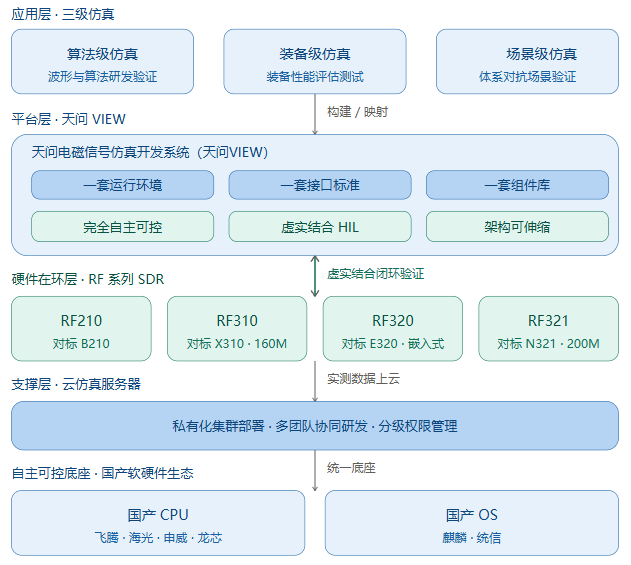
Tianwen Electromagnetic Signal Simulation & Development System(Tianwen VIEW):Built upon an open Software-Defined Radio (SDR) architecture, developed following the principle of "one runtime environment, one interface standard, one component library," it provides three-tiered simulation capabilities—algorithm-level, equipment-level, and operational-scenario-level—and runs natively on domestic CPUs (e.g., Phytium, Hygon, Sunway, LoongArch) and domestic OSes (e.g., Kylin, UnionTech), with fully independent intellectual property rights.
RF-Series General-Purpose Software-Defined Radio Hardware(RF210 / RF310 / RF320 / RF321):Serving as a real-channel and Hardware-in-the-Loop (HIL) verification node, it supports 1 MHz–6 GHz (with select models extended to 18 GHz) frequency range and up to 500 MHz instantaneous bandwidth, enabling one-click download of simulated waveforms into real RF chains for closed-loop validation.
Cloud-Based Teaching / Simulation Server:Supports private cluster deployment to enable multi-team collaborative R&D and hierarchical permission management.
III. Core Capabilities
Full-Stack Autonomy and Control:Core engine is entirely self-developed, eliminating dependence on foreign commercial software while ensuring compatibility with domestic software/hardware ecosystems.
Three-Tier Simulation Integration:Hierarchical mapping from algorithm-level → equipment-level → operational-scenario-level; simulation models are built once and reused across multiple tiers.
Virtual-Physical Hybrid Validation:Simulated waveforms can be seamlessly downloaded to RF-series hardware for closed-loop validation in real electromagnetic environments, significantly enhancing result credibility.
Scalable System Architecture:Supports elastic scaling—from single-node desktop development to multi-node cluster simulation—based on demand.
IV. Typical Application Scenarios
Development of novel waveform architectures; validation of radar/communications/navigation/electronic warfare algorithms; equipment performance evaluation and boundary testing; major project breakthroughs and technology transfer; compatibility verification within domestic software/hardware ecosystems.
V. Customer Value
1. Break free from constraints imposed by overseas commercial tools and establish an autonomous, controllable simulation toolchain;
2. Significantly reduce expenditures on software licensing and post-deployment maintenance;
3. Bridge the complete R&D loop spanning 'algorithms → equipment → operational scenarios,' shortening research cycles and improving technology transfer efficiency.
Research institutes, electronic research organizations, key university laboratories, and enterprise R&D centers.