Detecting Targets Without Emitting Signals: Can Cheap SDR Passive Radar Rewrite the Counter-Drone Warfare Landscape?

Figure: Silentium Defence Maverick S-series passive radar receiving array (Source: passiveradar.com)
Traditional radar actively emits radio waves outward and detects aircraft and drones via their echoes. But there is a special kind of radar that emits no electromagnetic waves whatsoever—it merely “listens” to broadcast signals already present in the environment. This is passive radar (Passive Radar).
“Passive radar is radar that doesn't need a transmitter; it uses existing broadcasts of opportunity.” ——passiveradar.com《How Passive Radar Works》
Ubiquitous civilian broadcast signals such as FM radio and digital TV (DVB-T) act as “illuminators of opportunity.” The radar receiver monitors the echoes these broadcast signals produce after bouncing off aircraft and drones; by analyzing the echoes it back-calculates the target’s position and velocity. Compared with traditional monostatic radar, passive radar needs no transmitting hardware and no radio-spectrum license, so its hardware cost can be made very low—its core hardware can even be built from off-the-shelf SDR (software-defined radio).
I. Core Physical Principles of Passive Radar: the Doppler Effect + Signal Time Delay
All radar detection relies on two major physical phenomena: the Doppler effect (Doppler shift) and signal time delay.
1. Doppler effect. When the wave source and the observed object move relative to each other, the received frequency shifts. A typical example is an ambulance whose pitch rises as it approaches and drops as it moves away. Radio signals follow the same rule:
• Target approaching the receiver: reflected-signal frequency rises (positive Doppler shift, blue shift)
• Target receding from the receiver: reflected-signal frequency drops (negative Doppler shift, red shift). The magnitude of the shift directly corresponds to the target’s radial velocity, which the radar uses to compute the target’s speed.
2. Signal time delay (time difference). Radio travels at the speed of light. The reflected echo arrives at the receiver later than the direct signal from the broadcast station, and this time difference represents the total length of the signal’s propagation path.
In a traditional active monostatic radar, the delay converts directly to distance; but in a passive bistatic radar, the delay corresponds not to a circle but to an ellipse.
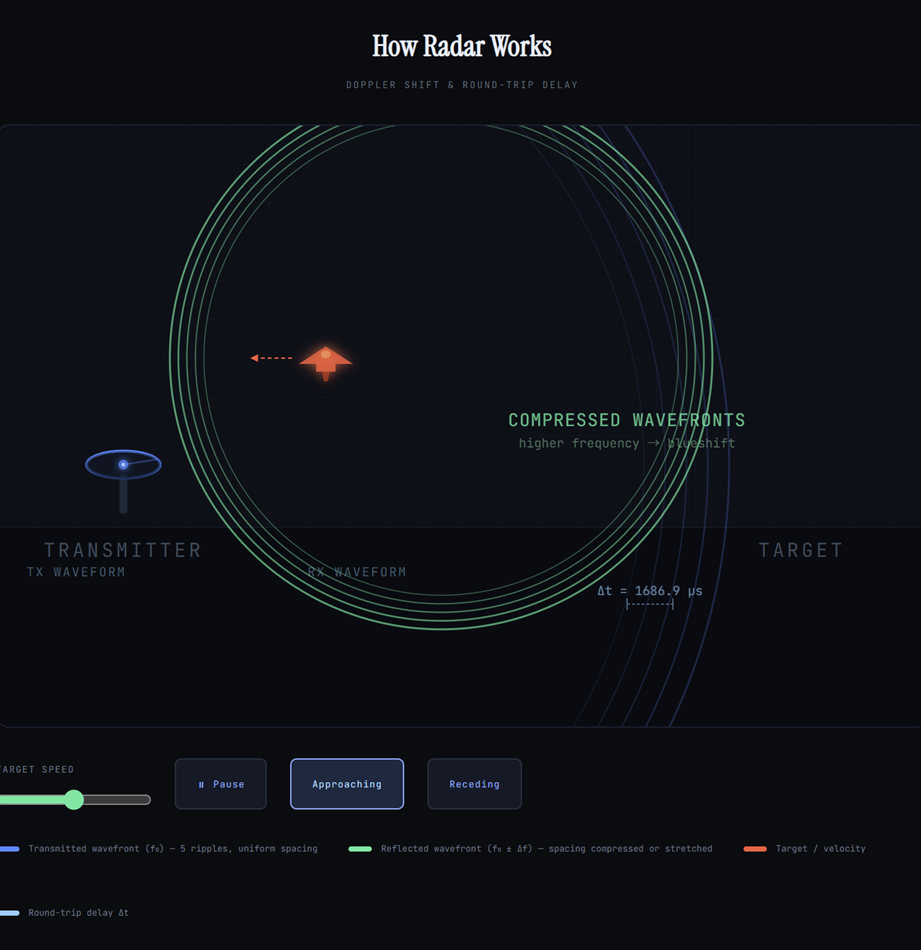
(See animated diagram: https://www.passiveradar.com/how-passive-radar-works/)
Figure: Working principle of bistatic passive radar—the transmitter and receiver sit at the two foci of an ellipse, and the target must lie on the ellipse curve (Source: passiveradar.com)
II. Bistatic Passive Radar: Target Localization via Ellipse Intersections
Passive radar is a classic bistatic radar: the illuminator (FM/TV transmitter tower) and the receiving sensor are not at the same location. The receiver picks up two signal paths simultaneously:
1. Direct signal: the radio wave that travels straight from the broadcast station to the receiver;
2. Echo signal: the broadcast signal that reaches the receiver after reflecting off a drone/aircraft.
The receiver compares the two signal paths and extracts the Doppler shift (velocity) and the time difference of arrival, TDOA (path difference). The time difference corresponds to an ellipse curve: the transmitter and receiver are the two foci of the ellipse, and all spatial points satisfying that delay lie on the ellipse. With only a single transmitter–receiver pair, one can only know that the target lies somewhere on the ellipse, not its exact coordinates.
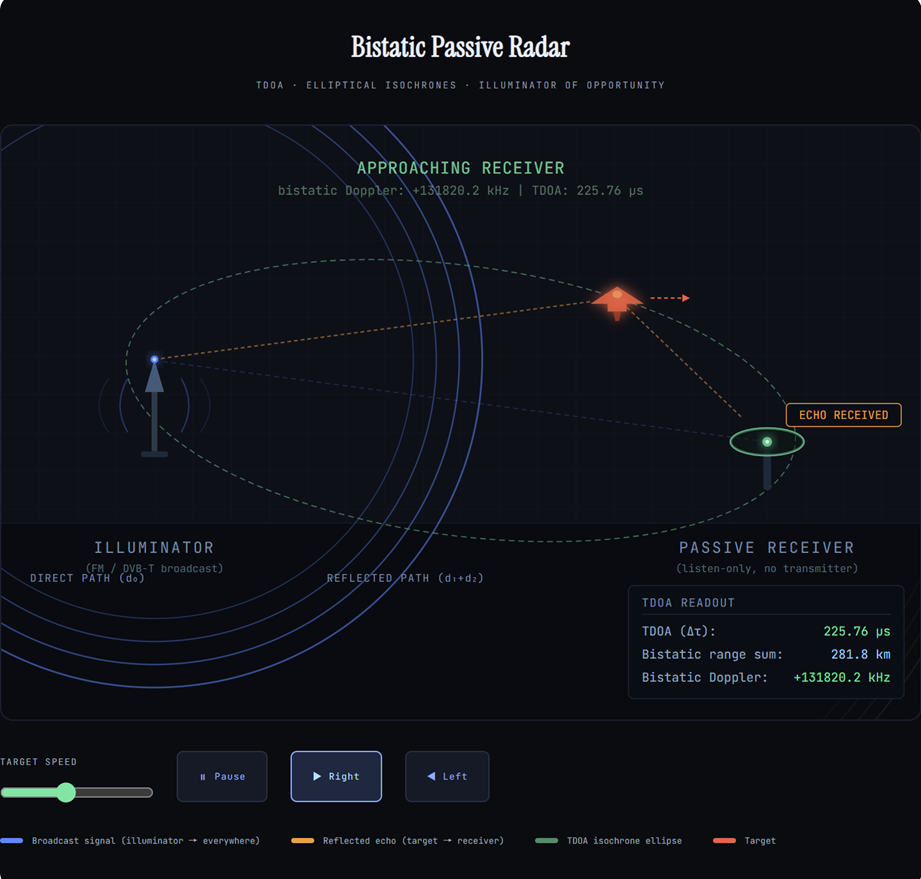
Figure: Multiple receiving units produce multiple ellipses; their intersection point is the target’s true position. At least three ellipses are needed to determine a unique spatial position (Source: passiveradar.com)
“One ellipse isn't enough to locate an object. But if you use multiple transmitters (or multiple receivers), each pair produces its own ellipse. The object's position is where those ellipses intersect.” ——passiveradar.com《How Passive Radar Works》
In suburban and urban environments there are often dozens of FM stations and digital-TV transmitter towers. Multiple illuminators combined with distributed receiving stations produce intersecting ellipses that can resolve the target’s two-dimensional position; adding receiving arrays separated in the vertical direction further resolves altitude information.
III. Analysis of Passive Radar’s Advantages and Disadvantages
Advantages
1. No transmitter, inherently covert: the equipment only receives and emits nothing, so enemy electronic reconnaissance cannot locate the radar itself;
2. Low hardware cost: a basic system can be built directly from commercial SDR (software-defined radio), an antenna, and a computer;
3. Low regulatory barrier: receiving radio signals is legal in most countries and requires no broadcast license;
4. Scalable: simply adding many receiving nodes expands coverage and improves localization accuracy, with no need to build transmitting infrastructure.
Inherent Shortcomings
1. Reliance on external third-party broadcast illuminators: in deserts or open wilderness lacking broadcast signals, capability drops sharply;
2. Limited accuracy: FM and DTV broadcasts have limited bandwidth, so range resolution can be on the order of hundreds of meters—far worse than the meter-level resolution of active radar;
3. Enormous signal-processing load: the direct broadcast signal is 60–80 dB stronger than the weak echo, requiring algorithms to separate the faint echo from the overwhelmingly strong direct signal;
4. A single receiver cannot resolve altitude and requires a multi-node network; environmental multipath reflections and clutter severely degrade detection performance.
IV. From Theory to the Battlefield: Hacker NewsForum Discussion — Ukraine’s Counter-FPVDrone Engineering Concept
After this popular-science article on passiveradar.com was published, it sparked extensive discussion on the overseas technical community Hacker News (thread ID: 47702890, mirror link: https://sbhn.g1b.me/item/47702890), where one highly upvoted reader comment linked passive radar with the FPV-drone threat on the Russia–Ukraine battlefield, proposing an engineering concept that deserves an objective look.
Important note: this passage reflects the personal views of forum users, is not an official document of the Ukrainian military, has not been confirmed as fielded or in service, and is merely a technical concept.
Paraphrase of the original comment by forum user “morphle”:
“Actually deploying passive radar in the Ukrainian combat zone faces enormous real-world difficulties: all radio emitters are constantly moving, the environment is full of reflection clutter from swaying leaves and camouflage nets, and is also saturated with many moving antennas and enemy jammers. A large share of current Russian casualties comes from fiber-optic FPV and cheap radio-controlled FPV drones. If we can build a usable passive radar, the key points are: ① network-based nanosecond-level time calibration (referencing the White-Rabbit clock protocol from high-energy physics experiments); ② densely deploying large numbers of cheap SDR receiving units on the ground; ③ pairing them with cheap decoy transmitters and jammers. This approach could save many lives and even shift the balance of force on the battlefield. The whole system requires vastly scaled signal computation and distributed supercomputing hardware cheaper than NVIDIA graphics cards.”
The core idea of this concept:
1. Deploy large numbers of low-cost SDR receivers across the ground to form a distributed receiving array;
2. Borrow the White-Rabbit Ethernet clock-distribution used in high-energy physics and the LOFAR 2.0 radio telescope to achieve network-wide nanosecond-level time synchronization;
3. Rely on multi-node ellipse intersections to localize FPV-drone targets, while deploying electronic-countermeasure decoys and jammers alongside;
4. Rely on cheap distributed computing clusters to perform clutter suppression and target association on massive volumes of I/Q RF sample data.
Meanwhile, another commenter on the same thread, with a background in naval radar engineering, raised a different, realistic objection:
“Multistatic radar is like controlled nuclear fusion in the radar field: the theoretical prospects are excellent, but it is always 20–30 years away from practical use. Maintaining nanosecond time synchronization on moving platforms and in sparse environments is extremely difficult engineering; at the same time, the civilian broadcast towers that serve as illuminators themselves become enemy targets. Civilian FM-band antennas are large, and range resolution is inherently inadequate.”
In other words: the distributed-SDR passive counter-drone approach is logically sound in theory, yet on a real battlefield full of interference and clutter it still faces many engineering hurdles. For now it belongs to the prototype R&D direction of civilian technical teams, not mature fielded equipment. The forum comment also revealed that the relevant civilian team is crowdfunding to develop prototype radars at different ranges—2 km, 10 km, and 60 km—hoping to donate and deliver them to soldiers on the Ukrainian front.
V. Future Implications of Passive Radar
“Ultimately, the reason there is increasing interest in passive radar is because it is accessible. No broadcast license, transmitter, and newly inexpensive hardware makes radar available to consumers and businesses in a way that wouldn't be possible only a few years ago.” ——passiveradar.com《How Passive Radar Works》
The rapid drop in SDR (software-defined radio) hardware costs means passive radar is no longer the exclusive domain of major powers’ military-industrial labs. It cannot fully replace traditional active radar, but in counter-drone operations, homeland low-altitude surveillance, and covert reconnaissance it is a highly promising supplemental tool.
In theory one could use FM broadcasts, digital TV, or even future Starlink satellite downlink signals as illuminators of opportunity; but moving targets, multipath clutter, network-wide high-precision time synchronization, and massive real-time signal processing remain the major mountains to climb before engineering deployment.
References
Original article: https://www.passiveradar.com/how-passive-radar-works/
Disclaimer: The Hacker News content in this article reflects the views of community users and does not represent official military technical documents. This article is for technical popular-science purposes only and does not constitute equipment evaluation.
This article is original content. When reposting, please credit the author, the source official account, and the official website (https://www.dyaotech.com). Unauthorized alteration or commercial use is prohibited; violators will be held accountable!