
Air Decoding: Integrated Innovation Experiment Course
This course is a comprehensive, tiered, and innovation-oriented wireless communication practice curriculum built on the Tianwen Qiming platform and powered by the Tianwen Visual Designer. It spans all academic levels—from undergraduate freshmen to graduate students—and bridges four core learning tiers: foundational introduction, principle analysis, security attack-defense, and innovative R&D—thereby addressing the traditional communication lab course pain points of fragmentation, over-theorization, and homogeneity. Leveraging real-world electromagnetic environment signal resources, the course features real-time visual interactive feedback, standardized validation assessments, and open-ended customizable experiments, establishing a closed-loop practical teaching system that is 'progressive, application-oriented, and innovation-driven.' It is adaptable to diverse educational scenarios including regular classroom instruction, hands-on training, course assessment, subject competitions, and capstone design projects.
- Product Materials
- 0 items
- Technical Specifications
- 0 items
INTRODUCTION
Product Overview
This course is a full-spectrum, tiered, and innovation-oriented wireless communication practice curriculum built on the Tianwen Qiming platform and powered by the Tianwen Visual Designer. It spans all academic levels—from undergraduate freshmen to graduate students—and bridges four core learning tiers: foundational introduction, principle analysis, security offense/defense, and innovative R&D—thereby addressing the traditional pain points of communication lab courses: fragmentation, over-theorization, and homogeneity. Leveraging real-world electromagnetic environment signal resources, the course features immediate visualized interactive feedback, standardized validation assessments, and open-ended customizable experiments, establishing a closed-loop practical teaching system characterized by “progressive learning, application-oriented instruction, and independent innovation.” It supports diverse pedagogical scenarios including regular classroom instruction, hands-on training, course assessment, subject competitions, and capstone design projects.
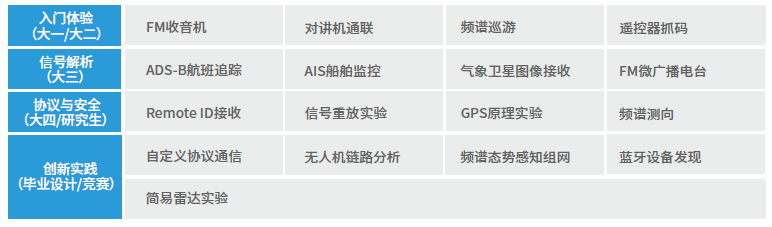
The course adopts an integrated modular design, with its four-tiered experimental structure interlinked and progressively advanced, forming a complete knowledge-and-competency development framework for wireless communication:
L1: Introductory Experience Tier (Freshmen & Sophomores; 30 minutes per experiment): Focuses on foundational cognitive awakening for absolute beginners, emphasizing engaging and lightweight experiments. Through hands-on labs—including FM radio reception, walkie-talkie communication, spectrum exploration, and remote-control code capture—students rapidly grasp core introductory concepts such as frequency modulation, spectral characteristics, wireless encoding, and basic communication modes. Intuitive auditory and visual feedback lowers the barrier to entry for communication专业知识, sparks interest in the discipline, and establishes a foundational conceptual framework.
L2: Signal Analysis Tier (Juniors; 60 minutes per experiment): Focuses on deepening professional principles, emphasizing analysis and application of real-world signals. Through practical labs—including ADS-B aircraft tracking, AIS maritime vessel monitoring, weather satellite image reception, and Bluetooth device discovery—students gain in-depth exposure to mainstream wireless communication protocols used in aviation, maritime operations, satellite systems, and short-range Bluetooth applications. They master core professional skills such as data checksumming, channel broadcasting, and signal demodulation/analysis—advancing their capability from “recognizing signals” to “interpreting signals.”
L3: Protocol & Security Tier (Seniors & Graduate Students; 90 minutes per experiment): Focuses on communication security and engineering implementation, emphasizing protocol deployment, security offense/defense, and signal localization. Advanced labs cover drone identification, signal replay attacks, GPS positioning principles, and spectrum direction-finding—closely aligned with national industry standards and cutting-edge application domains such as cybersecurity and wireless electronic warfare. Students acquire expertise in communication protocol security mechanisms, signal attack/defense principles, and cooperative localization techniques—meeting the needs of senior-level professional training and foundational research skill development.
L4: Innovation Practice Tier (Capstone Design, Subject Competitions; Open-ended): Focuses on independent R&D and innovation implementation, granting fully open experimental design permissions. Students may independently undertake innovative projects such as custom-protocol communication, drone link analysis, spectrum situational networking, FM broadcast system construction, or simplified radar development. The tier encourages students to transcend conventional lab frameworks—designing original experiments, building end-to-end communication systems, and delivering professional analytical reports and physical prototypes—comprehensively empowering high-level innovative talent development.
Core Course Value
This course breaks through the traditional limitations of communication lab education—“over-emphasis on theory, under-emphasis on practice, and lack of innovation”—and instead centers on four core features: integrated tiered instruction, realistic scenario-based practice, visualized real-time teaching, and open innovation empowerment. It forms a full-chain talent cultivation system spanning foundational cognition, specialized depth, secure application, and autonomous innovation. It meets both routine teaching and training requirements for university programs in Communication Engineering, Electronic Information Engineering, Internet of Things (IoT), and related disciplines, while also supporting students’ individualized development goals—including scientific innovation competitions, capstone design projects, and research initiation. Ultimately, it helps students build solid professional competence in wireless communication and cultivates interdisciplinary electronic information talents equipped with engineering hands-on capabilities, security-aware thinking, and independent innovation capacity.
SPECIFICATIONS
Technical Specifications
RESOURCES