
I. Directly Addressing Pain Points in Higher Education! Multiple Challenges in Traditional Laboratory Teaching Demand Immediate Solutions
With years of deep engagement in experimental teaching for higher education institutions, various shortcomings of traditional offline laboratories have long become common difficulties for both teachers and students, each precisely constraining improvements in teaching quality and efficiency:
- Diverse equipment categories lead to high operation & maintenance costs and low utilization rates
Communications and electronics experiments cover dozens of experiment types—including signal processing, RF communications, modulation/demodulation—requiring procurement of oscilloscopes, signal generators, spectrum analyzers, and other instruments under traditional teaching models.
- Outdated lab curricula lag behind rapid industrial technology evolution
The electronics and information industry evolves extremely rapidly: emerging technologies and applications—including 5G, Software-Defined Radio (SDR), and novel communication algorithms—are continuously deployed. However, traditional lab hardware is fixed and systems are closed; lab projects and course materials remain unchanged for extended periods, making updates difficult and time-consuming. Classroom content falls behind industry frontiers, restricting students to outdated, basic experiments and depriving them of exposure to mainstream industrial technologies—causing a serious mismatch between acquired knowledge and job requirements, and failing to meet the demands of New Engineering pedagogy, innovation instruction, and competition training.
- Cumbersome hands-on procedures restrict teaching in both time and space
Traditional physical experiments feature high operational thresholds and complex workflows: wiring, hardware debugging, and parameter calibration involve intricate steps, leading beginners to frequent errors and low experiment success rates. Moreover, such labs strictly depend on fixed locations and scheduled class hours, requiring in-person, synchronous operation—preventing fragmented self-study, post-class review, or remote training. They are entirely unsuitable for distributed teaching, holiday training, or online instruction, severely limiting students’ autonomous exploration and hindering development of independent debugging and engineering innovation capabilities.
- Inefficient teaching management and imprecise assessment & evaluation
Traditional lab teaching relies on manual administration and paper-based reports: course scheduling, user permissions, and experiment records are all manually tracked—resulting in low efficiency and high error rates. After experiments, students manually write reports and instructors manually grade them—a labor-intensive, time-consuming process that cannot fully trace students’ debugging steps, trial-and-error optimization, or iterative learning. Evaluation depends solely on final outcomes, lacking process-oriented assessment and thus failing to accurately gauge students’ hands-on proficiency and conceptual mastery—impeding targeted, individualized instruction.
II. A Breakthrough Solution! The Tianwen Cloud Teaching & Experiment System Redefines Practical Training
Targeting core pain points in higher-education laboratory instruction, the software-defined Tianwen Cloud Teaching & Experiment System—built upon fully proprietary core technologies—delivers an integrated teaching solution combining virtualization, networking, intelligence, and reconfigurability. By seamlessly merging virtual and physical environments, it dismantles traditional lab barriers and comprehensively supports all scenarios: routine teaching, training for competitions, and research-driven innovation across communications and electronic information disciplines.
Specifically designed for higher-education lab instruction, this platform revolutionizes traditional hardware-bound teaching models. Its core advantages—software-defined architecture, virtual-physical integration, reconfigurability, ease of upgrade, and full compatibility—enable deployment either as standardized, professional offline communications/electronics integrated labs or as cloud-based virtual simulation platforms—supporting remote teaching, online training, and hybrid virtual-physical instruction, thereby resolving all fundamental challenges of conventional labs.
Learn more about the product on our official website:https://www.dyaotech.com/
Try the system now at the trial access URL:http://yune.dyaotech.com:10000/
III. Cutting-Edge Technology Empowerment: Comprehensive Upgrading of University Lab Teaching Systems
- Self-developed open architecture ensures technical autonomy and seamless iteration
The system adopts an independently developed open Software-Defined Radio (SDR) architecture with complete intellectual property rights—overcoming the limitations of traditional commercial platforms (e.g., closed, black-box designs). It deeply integrates with the open-source SDR unified architecture and fully supports mainstream commercial SDR RF devices (e.g., USRP, RF210, B210), offering exceptional compatibility. It also supports custom component development: instructors can autonomously extend experiment modules per curriculum reform, technological advancement, or research needs—rapidly updating lab curricula to keep classroom instruction aligned with industry frontiers and fully resolving the problems of slow curriculum updates and outdated courses.
- Visual cloud-based operation simplifies workflows and breaks temporal-spatial constraints
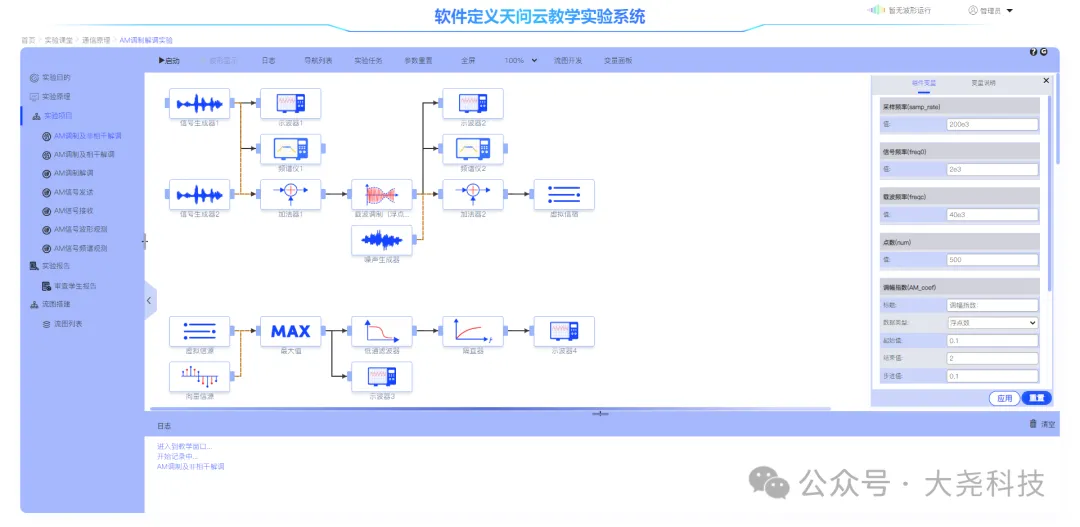
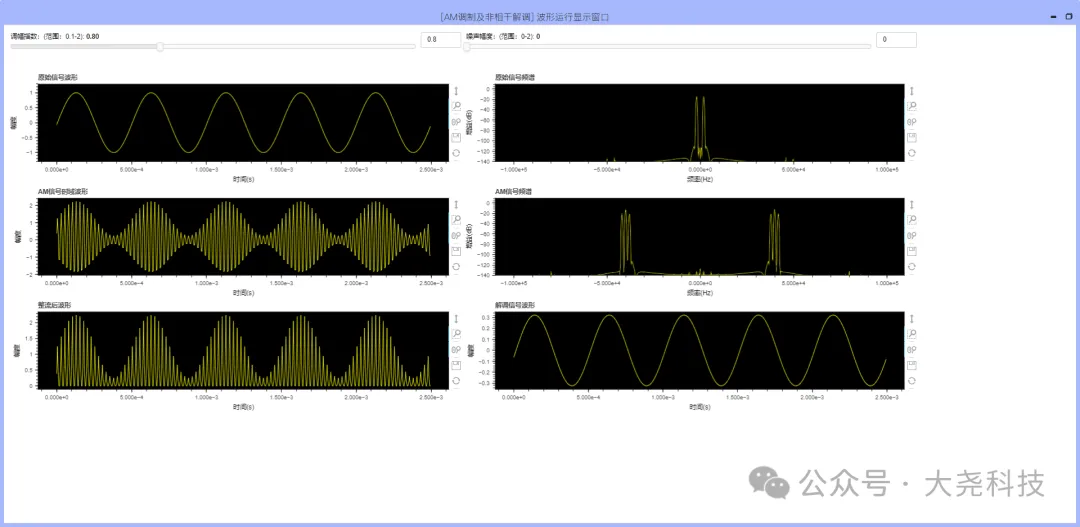
Powered by core Web-based visualization technology, the system supports online visual flowgraph construction, remote waveform execution control, real-time waveform display, and remote audio streaming. Without complex hardware wiring or tedious debugging, students perform experiment modeling, parameter tuning, and result observation directly via web browser—dramatically streamlining operations and lowering entry barriers. Simultaneously, it completely removes temporal-spatial constraints: enabling 7×24-hour cloud-based remote training. Students may log in anytime, anywhere for pre-class preparation, hands-on practice, or post-session review—fully supporting online instruction, after-class self-study, off-campus training, and competition preparation. True 'anytime, anywhere, on-demand training' is realized.
- Virtual-physical fusion enables multi-purpose use: one platform covers all experiment categories
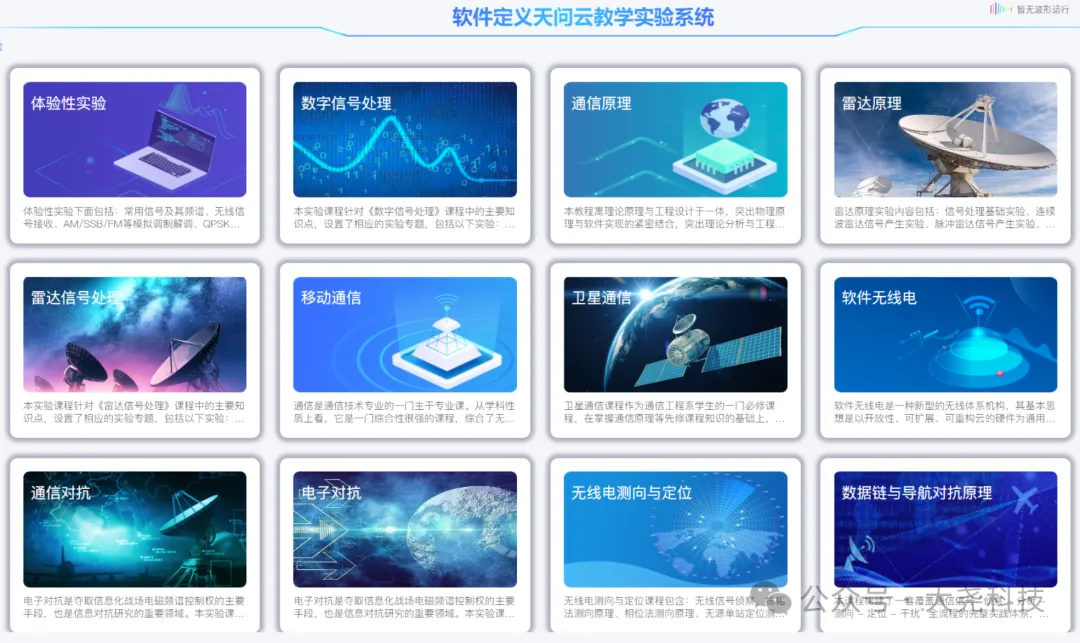
The platform delivers dual capabilities—virtual simulation and physical hardware experimentation—and embeds abundant communications/information algorithm components. Without stacking multiple hardware devices, users can rapidly construct experiments for Communications Principles, Signal Processing, RF Technology, Embedded Communications, and more. A single system replaces dozens of traditional instruments, accommodating foundational verification experiments, comprehensive design experiments, and innovative research experiments—perfectly matching diverse academic programs, educational levels, and teaching scenarios across universities. This significantly reduces lab procurement, operation/maintenance, and upgrade costs while maximizing equipment resource utilization.
- Intelligent teaching management: lightweight empowerment for instructors and students
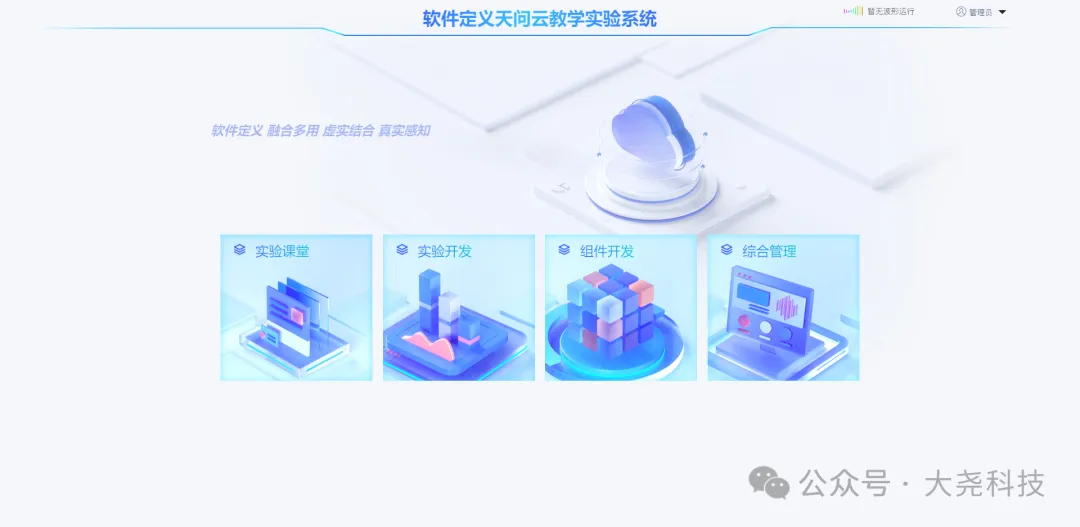
Equipped with a full-lifecycle intelligent teaching management system, it integrates tiered user management, course management, experiment project management, and real-time waveform execution monitoring. This helps instructors efficiently handle class scheduling, permission assignment, experiment supervision, and learning analytics—greatly reducing administrative burdens. It also supports automatic generation of experiment reports, fully recording students’ operational steps, parameter adjustments, and trial-and-error optimization processes. Experimental data is automatically aggregated and standardized reports generated—eliminating cumbersome paper submissions and manual grading. Assessment evolves from 'outcome-only evaluation' to 'precise, end-to-end evaluation', empowering instructors to accurately grasp student progress and deliver targeted instruction.
IV. Empowering New Engineering Education: Establishing a New Benchmark for University Lab Instruction
From reducing teaching costs and simplifying hands-on procedures, to accelerating curriculum iteration and enriching teaching scenarios, and further to optimizing teaching management and refining assessment systems—the software-defined Tianwen Cloud Teaching & Experiment System resolves traditional lab teaching bottlenecks through technological innovation.
It is not merely a teaching experiment system—it is a full-scenario teaching solution aligned with New Engineering talent cultivation reforms. It empowers universities to rapidly build modern, intelligent, and scalable communications and electronic information laboratories—driving lab instruction’s transformation from 'traditional hardware-based practice' to a new paradigm of 'virtual-physical integration, independent innovation, and precise talent development'. It efficiently cultivates high-caliber electronics and information talents equipped with solid hands-on skills, innovative thinking, and strong industrial adaptability—enhancing university program development, pedagogical reform, and talent quality improvement!